Last updated: 17 November 2026, evening (Asia/Calcutta). Figures below are taken from official Government of Canada pages. Where news reports say a Canada international student cap, the 2027–2029 Immigration Levels Plan itself uses the word “target.” Official arrival statistics on this page have been updated to 30 September 2026.
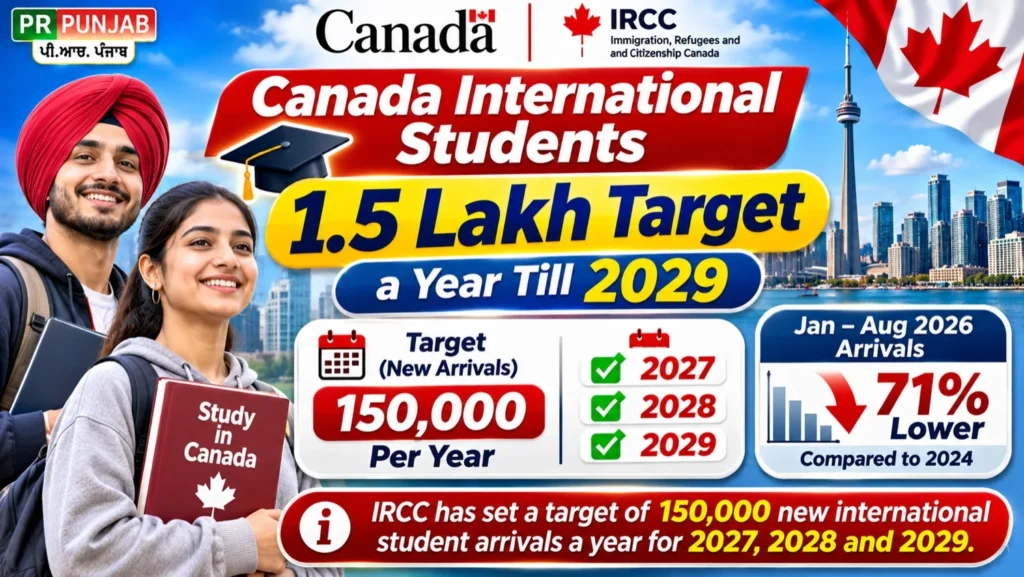
Canada has set a target of 150,000 new international student arrivals a year for 2027, 2028 and 2029. The figure is in the federal 2027–2029 Immigration Levels Plan, released on 5 November 2026. It is 1.5 lakh new arrivals in each of those years, not a promise that every study-permit application will be approved up to that number, and not a count of students already in Canada who only extend their permits.
That planned level sits against a sharp fall already visible in official data. From January to August 2026, IRCC recorded 65,210 new study-permit arrivals, compared with 221,670 in the same eight months of 2024 — a drop of 156,460, or about 71% (70.58% unrounded). With September now published, January–September 2026 arrivals were 83,110, against 250,540 in the same nine months of 2024 — a drop of 167,430, or about 67%.
Official position, in brief: Target — not a statutory cap on all study permits — of 150,000 new student arrivals in each of 2027, 2028 and 2029, inside a 370,000 overall target for new temporary arrivals (students about 40%; workers 220,000). The 2026 student target, set in the previous plan, was 155,000. The January–August comparison is still about 71% lower than in 2024. With September now published, January–September 2026 arrivals were about 67% lower than in the same nine months of 2024. The official table is dated as of 30 September 2026.
Table of Contents
What the 2027–2029 Levels Plan actually says
The Supplementary Information for the 2027–2029 Immigration Levels Plan sets targets and ranges for new arrivals of international students and temporary workers, alongside permanent-resident admissions. For international students, the planned target is 150,000 new arrivals in 2027, 2028 and 2029.
Two official caveats matter for students and families:
- It is a target for new arrivals, defined around foreign nationals studying for six months or more at a designated learning institution (DLI). It is not, in the document’s own wording, a cap on every study-permit decision IRCC may take.
- 2028 and 2029 figures are notional. IRCC has said they may be confirmed or adjusted by 1 November of the previous year. The 150,000 path can change in a later update.
The student target sits inside a broader temporary-resident target of 370,000 new arrivals a year. IRCC has described students as about 40% of that total, with a temporary-worker target of 220,000.
| Year (Levels Plan) | New international student arrivals (target) | Source / note |
|---|---|---|
| 2026 | 155,000 | 2026–2028 plan |
| 2027 | 150,000 | Kept in the 2027–2029 plan |
| 2028 | 150,000 | Notional in the 2027–2029 plan |
| 2029 | 150,000 | Notional in the 2027–2029 plan |
Canada international student cap: what IRCC actually means
Many Indian and international headlines describe the 1.5 lakh figure as a “cap” on new international students until 2029. That is a reasonable shorthand for a tight, multi-year arrivals target after two years of reductions, but it is not the word the official plan uses. This article follows the IRCC wording — target — and notes the popular “cap” language so that searchers can still find the explanation.
On its students and workers statistics page, IRCC also says the arrivals target “aligns with the annual international student cap, which limits the number of new study permits and extensions we issue.” That official “cap” language sits alongside the Levels Plan’s “target” for new arrivals. It still does not mean every study-permit decision, or every student already in Canada, is counted inside the 150,000 new-arrivals figure. The target also does not, by itself, fix how many study permits will be issued to applicants from any one country, including India, or from Punjab. Allocation still depends on IRCC processing rules, provincial attestation, and institution-level limits that are set out elsewhere.
The official drop in arrivals, including September 2026
IRCC publishes a monthly table of new study-permit arrivals. The version used for this update is dated as of 30 September 2026. IRCC rounds figures to the nearest 5, and a few monthly cells have been revised slightly since the earlier 31 August snapshot. The January–September 2026 official period total is 83,110.
| Period | New study-permit arrivals, 2024 | New study-permit arrivals, 2026 | Change |
|---|---|---|---|
| January–August | 221,670 | 65,210 | −156,460, or about 71% (70.58% unrounded) |
| January–September | 250,540 | 83,110 | −167,430, or about 67% (66.83% unrounded) |
The 2026 eight-month total is the sum of the official monthly cells now on the table: 6,925 (January), 2,130 (February), 2,070 (March), 4,880 (April), 3,320 (May), 3,015 (June), 5,795 (July) and 37,075 (August). September 2026 adds 17,900 arrivals, against 28,870 in September 2024 and 11,265 in September 2025. August remains the peak month so far in 2026, but it is itself much lower than August 2024 (79,655) and also lower than August 2025 (44,850). The January–September 2026 total of 83,110 matches the official period figure published on the same page.
Two limits on this comparison should be stated clearly. First, January–September is still not a full calendar year; later IRCC releases can add months and revise earlier cells. Second, arrivals are not the same series as permits issued or as the stock of students already in Canada. The “about 71%” figure refers to January–August, 2026 versus 2024. The “about 67%” figure refers to January–September. A separate IRCC headline on the same page, “61% fewer arrivals,” combines students and temporary workers; that is not the student-only percentage used here.
What the target does not include
- Study-permit extensions for students who are already in Canada.
- Applications made from inside Canada, as distinct from new arrivals.
- Asylum or protected-person pathways, which are counted elsewhere in the immigration system.
- Study of less than six months that does not fall under the DLI study-permit definition used for this target.
Families sometimes hear that “the cap is full” as soon as a college issues or withholds a letter. That claim cannot be checked from the national 150,000 target alone. The national figure is a planning level for new arrivals, not a daily public counter by country or by campus.
Official sources
- Supplementary Information for the 2027–2029 Immigration Levels Plan — 150,000 new student arrivals a year; 370,000 overall temporary-resident target; 220,000 workers; notional later years.
- Supplementary Information for the 2026–2028 Immigration Levels Plan — 155,000 student target for 2026 and 150,000 for 2027–2028.
- IRCC: Temporary students and workers — monthly statistics — new study-permit arrivals, data as of 30 September 2026, including the official January–September 2026 total of 83,110.
- Immigration, Refugees and Citizenship Canada — parent department.
Frequently asked questions
Canada ne international students te cap kitna laya hai 2027 ton 2029 tak?
The official 2027–2029 Immigration Levels Plan, released on 5 November 2026, sets a target of 150,000 new international student arrivals in each of 2027, 2028 and 2029. News reports often call this a cap. The government document itself uses the language of targets for new arrivals, not a blanket cap on every study-permit application.
1.5 lakh da matlab 150,000 hai? Eh hard cap hai ya target?
Yes, 1.5 lakh is 150,000. Immigration, Refugees and Citizenship Canada (IRCC) presents this as a planned target for new student arrivals (study of six months or more at a designated learning institution). It is part of a wider temporary-resident target of 370,000 new arrivals a year, of which students are about 40% and temporary workers 220,000. 2028 and 2029 student figures are described as notional and may be confirmed or adjusted by 1 November of the previous year.
71% drop kithon aaya? Official figure ki hai?
The January–August comparison is calculated from IRCC’s official monthly table of new study-permit arrivals, now dated as of 30 September 2026. January–August 2024 totals 221,670 and January–August 2026 totals 65,210 — a fall of 156,460, or about 70.58%, still commonly rounded to 71%. With September included, official arrivals are 250,540 in 2024 and 83,110 in 2026, a fall of 167,430, or about 67%. August remains the peak month so far in 2026 (37,075), against 79,655 in August 2024.
2026 da student target kitna si?
The earlier 2026–2028 Levels Plan set a target of 155,000 new international student arrivals for 2026, and 150,000 for each of 2027 and 2028. The new 2027–2029 plan keeps 150,000 for 2027 and extends that same target, on a notional basis, through 2028 and 2029.
Study-permit extension te in-Canada applications is 1.5 lakh vich count hunde ne?
No. The target applies to new arrivals of international students, not to every study permit IRCC may issue. The official methodology excludes extensions, applications made from inside Canada, and asylum-related cases, among other categories set out in the Levels Plan notes. A student already in Canada who extends a permit is not a new arrival under this target.
Chhe mahine ton ghatt de short courses vi is target vich aunde ne?
The student target is defined around study permits issued to foreign nationals studying for six months or more in Canada at a designated learning institution (DLI) approved by the province or territory. Shorter programmes that do not require that class of permit are not what this 150,000 figure is designed to count. Always check the official IRCC definition for a specific programme.
Temporary workers da target kitna hai?
Under the 2027–2029 plan, the overall target for new temporary resident arrivals is 370,000 a year. Of that, the worker target is 220,000 and the student target is 150,000. Those are arrivals targets, not a count of every work permit or study permit in the system.
2028 te 2029 de 150,000 figures final ne?
Not in the same way as the near-year figure. IRCC describes the 2028 and 2029 student targets as notional. They are to be confirmed or adjusted by 1 November of the prior year. The 150,000 figure is the planned path as of the 5 November 2026 release; it can still be revised in a later Levels Plan update.
Punjab de students layi is da ki matlab hai?
Punjab, like other Indian states, sends a large number of students to Canada. A lower arrivals target, together with the sharp fall already visible in 2026 official data, means fewer new study-permit arrival slots than in 2023–24. It does not, by itself, tell any one applicant whether a college offer will lead to a permit. Applicants should follow IRCC rules, provincial attestation requirements, and their institution’s DLI status, not informal “cap is over” messages.
Official numbers kithon check karan?
Use the Government of Canada pages: the 2027–2029 supplementary Levels Plan for the 150,000 target, the 2026–2028 plan for the earlier 155,000 (2026) figure, and the IRCC students and workers statistics for monthly arrivals. Those are the primary sources for this article.
Arrival te study permit vich farak ki hai?
An arrival, in this table, is a new international student entering Canada on the relevant study permit. IRCC also publishes other series, such as permits issued or the stock of study-permit holders already in the country. The “about 71%” comparison uses the official new-arrivals table for January–August, 2024 versus 2026. The “about 67%” comparison uses January–September. Neither figure is a count of every approval letter.
Kya 2026 de pehle aath mahinean da data complete hai?
IRCC’s table used here is dated as of 30 September 2026. September has now been published (17,900 arrivals). January–September is still not a full calendar year, and later releases can revise earlier cells. We will update the percentages if IRCC revises the table or publishes full-year 2026 figures that change the comparison.
This article is a plain-language reading of official IRCC planning documents and statistics. It is not immigration advice and not a substitute for the latest instruction on a study-permit application. Always check the Government of Canada pages linked above, because targets and monthly tables can be revised.