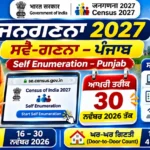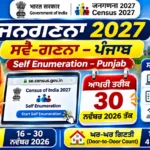
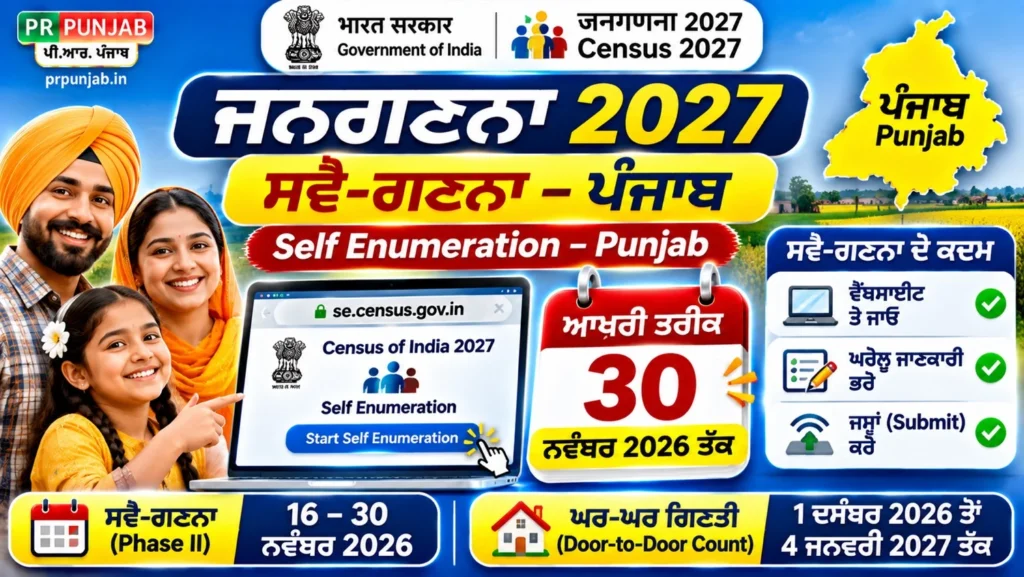
Census 2027 self enumeration in Punjab is open now. From 16 to 30 November 2026, any household in Punjab can fill its own census details online at se.census.gov.in instead of waiting for the enumerator. This is the second phase of Census 2027 — Population Enumeration — and it is the last chance to self-enumerate before the door-to-door count begins on 1 December 2026.
This guide explains, in plain words, what the facility is, the exact Punjab dates, how to fill the form step by step, all 40 questions, what to do with your SE ID, and how to stay safe from fake census calls. Everything below is taken from official notices (PIB, the Census of India and the Gazette); where something is not officially confirmed, we say so.
Table of Contents
Quick answer: Punjab self-enumeration dates and link
Open now: 16 November 2026 to 30 November 2026 (Punjab, Phase II).
Official link: https://se.census.gov.in
Time needed: about 25–30 minutes for a family (CM Bhagwant Mann’s own estimate). No documents are uploaded.
After that: enumerators visit every home from 1 December 2026 to 4 January 2027; give them your SE ID.
Closing time on 30 November: not announced officially — please finish a day or two early.
Source: PIB, 16 November 2026 and The Tribune, 16 November 2026.
What is self-enumeration in Census 2027?
Self-enumeration (SE) is an optional, web-based facility that lets a household enter its own census information on a government portal. It is a first for India: Census 2027 is the country’s first fully digital census, and it is also the 16th census since 1872 and the 8th since Independence.
Census 2027 is being done in two phases, and self-enumeration is offered before each of them:
- Phase I – Houselisting and Housing Census (HLO): about the building, amenities and assets (33 questions). Punjab completed this phase earlier in 2026.
- Phase II – Population Enumeration (PE): about every person in the household — age, education, work, migration, religion, caste and more (40 questions). This is the phase now open in Punjab.
If you self-enumerated in Phase I, you still need to do it again for Phase II, because the questions are completely different. PIB has asked households to use the same mobile number they used in Phase I, where possible.
Punjab self-enumeration dates and the full Census 2027 timeline
Punjab is among the first states to run Phase II, because the state was advanced in the national schedule. The national reference date of the census is 00:00 hours on 1 March 2027, but snow-bound areas and a few states, including Punjab, have been given earlier windows.
| Stage | Punjab dates | Status |
|---|---|---|
| Phase I self-enumeration | 30 April – 14 May 2026 | Closed |
| Phase I house listing (HLO) | 15 May – 13 June 2026 | Completed |
| Phase II self-enumeration | 16 – 30 November 2026 | Open now |
| Phase II door-to-door Population Enumeration | 1 December 2026 – 4 January 2027 | Upcoming |
| Revisional round | 5 – 9 January 2027 | Upcoming |
| Reference date for Punjab | 00:00 hours, 5 January 2027 | — |
For comparison, the rest of the country (non-snow-bound areas) will self-enumerate from 10 to 24 January 2027, with Population Enumeration from 25 January to 28 February 2027, a revisional round from 1 to 5 March 2027 and the reference date of 1 March 2027. Snow-bound areas — Ladakh and the snow-bound parts of Jammu & Kashmir, Himachal Pradesh and Uttarakhand — were counted first, from 1 to 30 September 2026, with a revisional round from 1 to 5 October 2026 and a reference date of 1 October 2026.
Nationally, house listing ran between 1 April and 30 September 2026, with every state getting a 15-day self-enumeration window followed by a 30-day house listing. Sources: Census of India SE/HLO schedule, PIB Chandigarh, All India Radio. The census dates also explain why the Punjab Assembly poll is unlikely before January — see our Punjab Election 2027 date guide.
How is Punjab doing? In Phase I, only about 1.5 lakh people in Punjab self-enumerated. In Phase II, by 19 November 2026, 61,814 households had started the form but only 29,224 had finished it — a completion rate of 47.28%, according to Dainik Jagran. Pathankot led the districts and Ludhiana was last. The lesson: starting is not enough — you must press Final Submit.
Before you start: what to keep ready
No document has to be uploaded, and the enumerator will not ask for proof either. But you will answer faster if you have this information handy for every person who normally lives in your house:
- One mobile number for the whole household (preferably the one used in Phase I) that can receive an OTP.
- Full names, dates of birth and relationship to the head of household.
- Education, occupation and place of work details.
- Place of birth and, if anyone moved, the previous place of residence and reason.
- Aadhaar, Voter ID, passport and driving licence numbers only if you wish and they are available — the notification marks these as “if available”.
- A laptop or computer is recommended for the map step; a phone also works.
- A stable internet connection — the form cannot be filled offline.
How to do Census 2027 self enumeration: step by step
The steps below follow the official self-enumeration user guide and FAQ released for Phase I (Census FAQ PDF). The Phase II login works the same way, but the questionnaire screens are person-wise; minor screen labels may differ.
Step 1: Open the portal
Go to se.census.gov.in (type it yourself — do not click links received on WhatsApp or SMS). Select your State as Punjab and enter the captcha.
Step 2: Enter the head of household and mobile number
Type the name of the head of household. This cannot be changed later. Enter one mobile number for the household and, optionally, an email ID.
Step 3: Choose language and verify OTP
Pick your language. Punjabi, Hindi and English are all available among the 16 languages. The language cannot be changed after this step. Enter the OTP received on your mobile.
Step 4: Enter your address and mark your house
Fill in district, PIN code, village or town, locality and a landmark, then click Search. A map opens: drag the red marker exactly onto your house and click Save & Next.
Step 5: Fill in details for every member
Answer the Population Enumeration questions for each person who usually lives in the household, starting with the head. Answer for the situation as of the census period, not for relatives living elsewhere.
Step 6: Preview, then Final Submit
Use Preview to check every answer. You can save as a draft and come back, but your entry counts only after you press Final Submit.
Step 7: Save your SE ID
After Final Submit, a Self-Enumeration ID (SE ID) appears on screen and is sent by SMS (and email, if given). In Phase I it was an 11-digit number. Take a screenshot or write it down. If you lose it, you can retrieve it on the portal with your registered mobile number.
The 40 questions in Census 2027 Population Enumeration
The questions were notified in the Gazette under S.O. 4505(E) dated 14 August 2026 (notification PDF). Here is the complete list:
- Name of the person
- Relationship to head of household
- Sex
- Date of birth and age
- Current marital status
- Age at marriage
- Name of spouse
- Nationality
- Religion
- Scheduled Caste / Scheduled Tribe / caste
- Father’s particulars
- Mother’s particulars
- Disability
- Mother tongue and other languages known
- Literacy and digital literacy
- Attending an educational institution
- Highest educational level attained and stream
- Worked any time during the last year
- Category of economic activity
- Occupation
- Nature of industry, trade or service
- Class of worker
- Non-economic activity
- Seeking or available for work
- Travel to place of work
- Place of birth
- Place of last residence
- Reason for migration
- Duration of stay at the present place
- Permanent residential address
- Number of children surviving
- Number of children ever born alive
- Children born alive during the last one year
- Place of Covid-19 vaccination
- Number of bank accounts
- Mobile number (if available)
- Aadhaar number (if available)
- Voter ID / EPIC number (if available)
- Passport number (if an Indian passport holder)
- Whether a driving licence is available
A few points: questions 31–33 are about children born to women in the household; questions 36–40 are “if available” and you will not be penalised for not having these documents; and question 15 asks about digital literacy, which is new in this census.
What happens after you submit
- Between 1 December 2026 and 4 January 2027, an enumerator will still visit your house.
- Give the enumerator your SE ID. They will pull up your record, verify it with you and finish the entry — this saves time for both sides.
- You can edit your form yourself until Final Submit or until the window closes. After that, only the enumerator can correct mistakes during the visit.
- If nobody was home, the revisional round from 5 to 9 January 2027 is meant to catch missed households.
Is self-enumeration mandatory? Privacy and caste
Self-enumeration is optional. If you skip it, the enumerator will collect the same details at your door. Taking part in the census itself, however, is a legal duty under the Census Act, 1948, so please give correct answers either online or to the enumerator.
Privacy: According to PIB, information collected is strictly confidential under the Census Act, 1948 and the Census Rules, 1990. It is used for statistical purposes only, cannot be used for taxation, police investigation or as evidence in court, and is not available under the RTI Act.
Caste: Question 10 records whether a person belongs to a Scheduled Caste or Scheduled Tribe, and their caste. Census 2027 enumerates caste as part of Phase II, which makes it one of the most closely watched parts of this exercise.
Beware of census fraud
Remember: No census official will ever ask for your OTP, bank details, card PIN or money. Enumerators will not send you links to “verify” your census. Self-enumeration is free. Only trust se.census.gov.in, and give information only to staff carrying a valid photo ID card.
Self-enumeration is done on the website; we could not find any official self-enumeration app for the public, so be careful with apps claiming to be one. The census mobile app is used by enumerators for field work. For help, PIB has listed a toll-free census helpline, 1855. You can also contact your district administration or the Directorate of Census Operations, Punjab.
Missed the window? Common problems and fixes
- Missed 30 November? Nothing to worry about. The enumerator will count you between 1 December 2026 and 4 January 2027.
- OTP not coming? Check the number, wait a minute and retry. Network delays are the most common reason forms stay incomplete.
- Captcha not loading / district not showing? Refresh, try another browser or a laptop, and avoid peak evening hours.
- Wrong language or head of household chosen? These cannot be changed online; complete the form and get the enumerator to correct it.
- Started but not finished? Log in again with the same mobile number, open the draft and press Final Submit.
- Hostel, jail, hospital or houseless? Institutional and houseless households cannot self-enumerate; they are counted by enumerators.
Prefer Punjabi? Read this guide in Punjabi: ਜਨਗਣਨਾ 2027 ਸਵੈ-ਗਣਨਾ ਪੰਜਾਬ.
Official links
| What | Link |
|---|---|
| Self-enumeration portal | se.census.gov.in |
| Census of India | censusindia.gov.in |
| PIB release on Phase II SE (16 Nov 2026) | pib.gov.in |
| 40 questions – Gazette S.O. 4505(E) | Notification PDF |
| Phase I SE/HLO schedule by state | Schedule PDF |
| Self-enumeration FAQ (Phase I) | FAQ PDF |
| Census helpline | 1855 (toll-free) |
Frequently asked questions
What is the last date for Census 2027 self enumeration in Punjab?
The Phase II self-enumeration window in Punjab is 16 to 30 November 2026. The closing time on 30 November has not been announced, so finish a day or two early.
What is the official self enumeration link?
The only official portal is https://se.census.gov.in. Type it yourself and do not use links sent on WhatsApp or SMS.
Is self enumeration mandatory?
No. Self-enumeration is optional. If you skip it, the enumerator will collect your details at home between 1 December 2026 and 4 January 2027.
Can I fill the census form in Punjabi?
Yes. The portal offers 16 languages, including Punjabi, Hindi and English. The language cannot be changed after you choose it.
Which documents are needed for self enumeration?
No documents are uploaded. Aadhaar, Voter ID, passport and driving licence numbers are asked only if available.
I did self enumeration in Phase I. Do I need to do it again?
Yes. Phase II asks 40 different questions about every person, so it needs a fresh submission. Use the same mobile number as Phase I if possible.
What is the SE ID and what do I do with it?
It is the Self-Enumeration ID shown after Final Submit and sent by SMS. Give it to the enumerator when they visit, so they can verify your entry.
Is my census data safe?
Yes. Under the Census Act, 1948 and Census Rules, 1990, census information is confidential, used only for statistics and not available under RTI. Never share OTPs or bank details with anyone claiming to be from the census.
Sources: PIB (16 Nov 2026), PIB Chandigarh, PIB Raipur, Gazette S.O. 4505(E), Census of India, SE FAQ, The Tribune, Dainik Jagran, AIR. Last checked: 22 November 2026. Portal screens may change; always follow the instructions shown on se.census.gov.in.